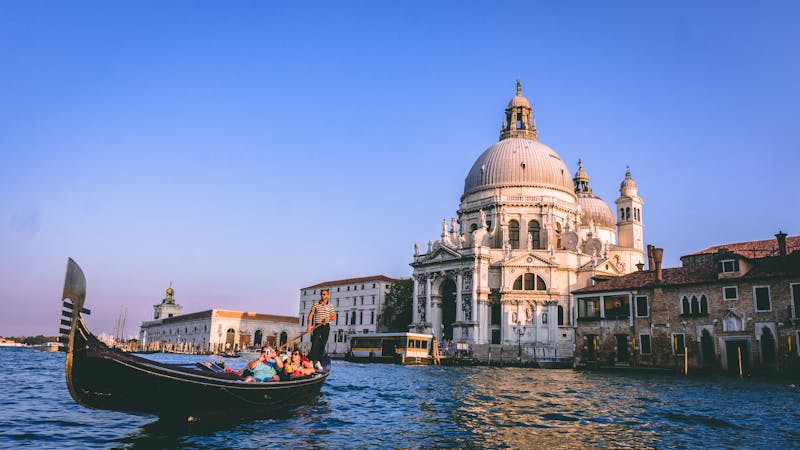
Venice is explored on foot. From Rialto Bridge to St Mark's Square is 600 metres but a real 15 minutes through calli and bridges. The six sestieri (San Marco, Castello, Cannaregio, Dorsoduro, San Polo, Santa Croce) have distinct characters: San Marco is the tourist heart, Castello working-class, Cannaregio residential Venice, Dorsoduro the university zone with museums and bacari, San Polo the Rialto market area. For Murano, Burano and Torcello budget half a day by vaporetto. Google Maps works but often misleads: look for the yellow signs on walls (Ferrovia, Rialto, San Marco, Accademia) — they are the only reliable directions. The acqua alta from October to March can be tracked on the "hi!tide Venice" app: walkways activate above +110 cm.
📜 History at a glance
Venice was founded in the 5th century as a refuge for mainland dwellers fleeing barbarian invasions. In 697 it elected its first doge, beginning an oligarchic republic that lasted 1,100 years — the longest-running regime in European history. From the 10th to the 15th century it dominated Mediterranean trade: routes to Constantinople, Egypt, the Levant, the Black Sea. The Fourth Crusade of 1204 (sack of Constantinople) brought it the four horses of St Mark and the Byzantine treasures. The 14th century marked the peak: 200,000 inhabitants, a thousand ships, the Arsenal capable of launching a galley a day. Marco Polo (1254-1324) returned from China in 1295 with the account that changed European geography. The decline began in 1453 with the fall of Constantinople and accelerated with the discovery of America: oceanic routes bypassed the Mediterranean. On 12 May 1797 Napoleon ended the Serenissima without a battle. After Vienna it was Austrian, then Italian from 1866. Today permanent residents have dropped to 49,000, against 21 million annual visitors.
📅 Best time to visit
April-June and September-October offer the best balance: 15-25°C, long days, before and after the worst crowds. Carnival (10 days in February) is spectacular but doubles prices. July-August is sweltering (30-35°C), suffocating humidity, mosquitoes in the lagoon-facing sestieri, intolerable crowds at San Marco. November-March is true low season: 5-12°C, fog, rain, but hotels at half price and sights enjoyable without queues. Acqua alta is frequent between October and February (mid 50-100 cm events, exceptional ones above 140): the Mose system has blocked it above +110 cm since 2020. December and early January bring markets and a Christmas atmosphere. Avoid if you want elegance: the 25 April, 1 May and mid-August bank holidays, packed with Italian tourists.
🏛️ Why visit Venice
St Mark's Basilica — basic entry free 9:30-17:15 (Sunday 14:00-17:00); €3 the Treasury, €5 the Pala d'Oro, €7 the Loggia dei Cavalli with terrace. Online booking €6 recommended to skip the queue. Doge's Palace + St Mark's Square Museums — combined ticket €30 (includes Museo Correr, Archaeological, Marciana), 9:00-19:00, valid 3 months. Secret Itineraries +€28 with guide. St Mark's Campanile — €12, 9:30-21:15 summer / until 17:15 winter, lift, 360° view. Accademia Galleries — €15, 8:15-19:15 (Monday until 14:00): Bellini, Titian, Veronese, Tintoretto, Carpaccio. Peggy Guggenheim — €16, Wed-Mon 10:00-18:00, Picasso/Pollock/Magritte in a palazzo on the Grand Canal. Ca' Rezzonico — €10, Museum of 18th-century Venice. Scuola Grande di San Rocco — €10, cycle of 60 Tintoretto canvases. La Fenice Theatre — €12 audio-guide tour 9:30-18:00. Murano-Burano-Torcello — half-day by vaporetto, Murano glass (Museum €10), Burano coloured houses, Torcello paleo-Christian cathedral €5.
🗓️ Suggested itineraries
1 day: arrive, leave bags at Ferrovia/Piazzale Roma, vaporetto line 1 along the Grand Canal (€9.50, but included in the €25 day pass), bacaro lunch in San Polo, afternoon St Mark's Square + Basilica + Doge's Palace (3h, book ahead), dinner in Castello. 3 days: day 1 as above; day 2 Accademia + Guggenheim + Zattere + Dorsoduro on foot (morning), afternoon Frari + Scuola di San Rocco + Rialto market + cicchetti tour, evening Fondamenta Misericordia; day 3 Murano-Burano-Torcello (vaporetto 12/4.1, full day) or Lido (line 1 or 2). 7 days: the 3 above + day 4 Biennale at the Giardini/Arsenal (if open, May-November, 8 hours minimum), day 5 Padua (30-min train, Giotto's Scrovegni Chapel), day 6 Verona and the Arena (1h10 train), day 7 Treviso or Chioggia ("little Venice"). Alternative: 2 nights on Murano to enjoy the island after the tourists leave at 18:00.
🍽️ Local cuisine
Venetian seafood cuisine. Cicchetti: local tapas paired with ombre (small glasses of wine) in the bacari, €1.50-3 each. Classics: baccalà mantecato, sarde in saor, polpette, octopus, mozzarella in carrozza, folpetti. Pasta: bigoli in salsa (anchovies and onions), squid ink risotto, risi e bisi, pasta and beans, spaghetti with clams. Mains: liver Venetian-style with polenta, baccalà alla vicentina, mixed lagoon fry, moeche (soft-shell crabs, spring and autumn). Desserts: tiramisù (invented in nearby Treviso), zaeti, baicoli, fritole at Carnival. Historic bacari: Cantina Do Mori (since 1462, the oldest) in San Polo, All'Arco in Rialto, Al Timon in Cannaregio, Osteria al Squero in Dorsoduro. Tourist traps: any restaurant with a 6-language photo menu near San Marco. Look for side calli: Cannaregio (Fondamenta della Misericordia) and Castello (via Garibaldi) have honest prices. Bacaro lunch €15-20, trattoria dinner €35-50 with wine.
🗺️ Neighbourhoods to explore
San Marco: tourist heart, high prices, always crowded, but unmissable for the Square and Doge's Palace. Castello: the largest sestiere, working-class and residential, Arsenal, Biennale at the Giardini and Arsenal, Via Garibaldi with honest bacari. Cannaregio: the Venice locals live in, Jewish Ghetto (the world's first, 1516), Fondamenta della Misericordia for evening aperitivo, near Ferrovia station. Dorsoduro: university zone Ca' Foscari, Accademia, Guggenheim, Squero di San Trovaso (gondolas), Zattere for waterfront walks. San Polo: the smallest, Rialto market (Mon-Sat morning), Frari, Scuola di San Rocco. Santa Croce: entry from Piazzale Roma (the only car parking), less touristy. Giudecca: island to the south, former industrial, now artisan studios and the Redentore (July Redentore festival with fireworks). Murano: blown glass. Burano: lace and coloured houses. Torcello: northern lagoon, 639 AD cathedral.
🎭 Events and festivals
February: Venice Carnival, 10 days of masks, balls and parades, Flight of the Angel from San Marco (Fat Thursday). 25 April: St Mark's feast day, Bucintoro regatta, festa del bocolo (men give a rosebud to the women they love). May (Ascension): Sposalizio del Mare, the doge throws a ring into the sea at the Lido. May-November (odd years): Art Biennale, Giardini and Arsenale. June-November (even years): Architecture Biennale. Third Sunday of July: Festa del Redentore, pontoon bridge and fireworks over St Mark's Basin. Late August - early September: Venice Film Festival at the Lido, 11 days, red carpet. First Sunday of September: Historic Regatta, parade of historic boats and races on the Grand Canal. 21 November: Festa della Madonna della Salute, pontoon bridge, remembrance of the 1631 plague.
✈️ How to get there
Venice has two airports. Marco Polo (VCE) on the mainland at Tessera, 13 km from the centre: main hub for international flights (ITA Airways, Lufthansa, KLM, easyJet, Vueling). Domestic flights from Rome €40-100 (1h10), Naples €60-130 (1h20), Catania €70-160 (1h45). From Europe: London 2h €40-180, Paris 1h50 €50-200, Amsterdam 1h45 €60-200, Frankfurt 1h30 €70-220. Treviso (TSF), 30 km from Venice, is the low-cost airport (Ryanair, Wizz Air): flights often €20-50 cheaper but an extra transfer is needed. Useful alternative: high-speed Frecciarossa/Italo trains from Rome 3h40 €40-95, from Milan 2h25 €25-80, from Florence 2h €30-75, from Bologna 1h25 €20-60. Trains arrive at Santa Lucia (in the historic centre) or Mestre (mainland): pick Santa Lucia.
🚇 Getting around
ACTV runs vaporetti, buses and trams. Vaporetto: single ticket €9.50 valid 75 min (steep, but that's it); tourist passes far better value: 24h €25, 48h €35, 72h €45, 7-day €65. Key lines: 1 (slow, every Grand Canal stop), 2 (fast, Tronchetto-San Marco), 4.1/4.2 (lagoon loop), 12 (Fondamente Nove-Murano-Burano-Torcello). From Marco Polo: Alilaguna (€15 one-way, €27 return) fast boat 75-90 min to San Marco / Rialto / Ferrovia; ACTV bus 5 or ATVO €10 in 20 min to Piazzale Roma; water taxi €120-150 for 1-4 people, 30 min direct, luxurious but pricey. From Treviso: ATVO coach €12 in 70 min to Piazzale Roma. Traghetto (public gondola crossing the Grand Canal): €2 per crossing at the 7 points without bridges, the traditional ferries. Tourist gondola: official rate €90 (day) or €110 (evening) for 30 min, up to 6 people — not for getting from A to B but for the experience. No cars at all in Venice, parking at Tronchetto (€21/day) or Piazzale Roma (€26/day), or better still at Mestre/San Giuliano with a €1.50 tram to the centre.
💰 Budget and prices
Return flight from Italy €40-150, from Europe €70-250 in low season, up to €500 at Carnival or mid-August. Hotel: hostel/B&B €30-60/night shared dorm or budget single; 3-star historic centre €100-180 low season, €180-350 peak; 4-star €180-350 / €350-700; historic palazzi above €500. Mestre is 40-50% cheaper: 3-star €60-110 + 15-min tram to the centre. AirBnB studios in Cannaregio/Castello €80-150, check-in after 20:00 prohibited. City tax: €1-5/night by hotel category. Day-tripper fee: since April 2024 day visitors pay a €5 access fee on high-attendance days. Meals: cicchetti €1.50-3 each (you need 4-6 + 1-2 ombre = €15-20 per person); trattoria lunch €25-35; good trattoria dinner €40-60 per person with wine; Michelin restaurant €120-300. Coffee at the counter €1.20-1.50; sit-down at San Marco up to €10. Transport: 72h pass €45 essential. Weekend total for two (excluding flights): €450-700 in low season, €700-1,300 in high.
📋 Practical info
Currency euro. Italian language, Venetian dialect in the bacari (e.g. "spritz" is not Roman), English widely spoken. Tipping not mandatory: the €2-4 coperto is often already on the bill. Acqua alta: "hi!tide Venice" app shows forecasts; walkways activate above +110 cm (Mose blocks higher). Rubber boots for sale everywhere at €5-10. Getting lost: you always have 4 yellow signs in sight (Ferrovia, Rialto, San Marco, Accademia); follow the right one. Access fee: €5 for day visitors on high-attendance days (since April 2024) — check cve.comune.venezia.it. Mosquitoes: bring repellent June-September, especially in the lagoon-facing sestieri (Castello). Plugs type F/L 230V. Public WiFi: VeniceConnected, free after registration. Useful apps: AVM Venezia Official (vaporetto schedules), iMUSE for civic museums, hi!tide for acqua alta.
💡 Practical tips
- Buy a 72h vaporetto pass or longer: single tickets at €9.50 are a rip-off.
- Cicchetti tour: 4 bacari × 2 cicchetti + 1 ombra = €25 per head, authentic local experience.
- Murano-Burano-Torcello: leave at 8:00 from Fondamente Nove, ahead of the tour groups.
- No San Marco photos by day: the empty squares are most beautiful at 6:00-7:00 in the morning.
- Sleep in Mestre to save 40-50%, 15 min by tram to the centre.
- Group gondola (6 people): €15-18 per head versus €90 as a couple.
- Skip the tourist gondola at San Marco: pick Cannaregio or San Polo for silent narrow calli.